


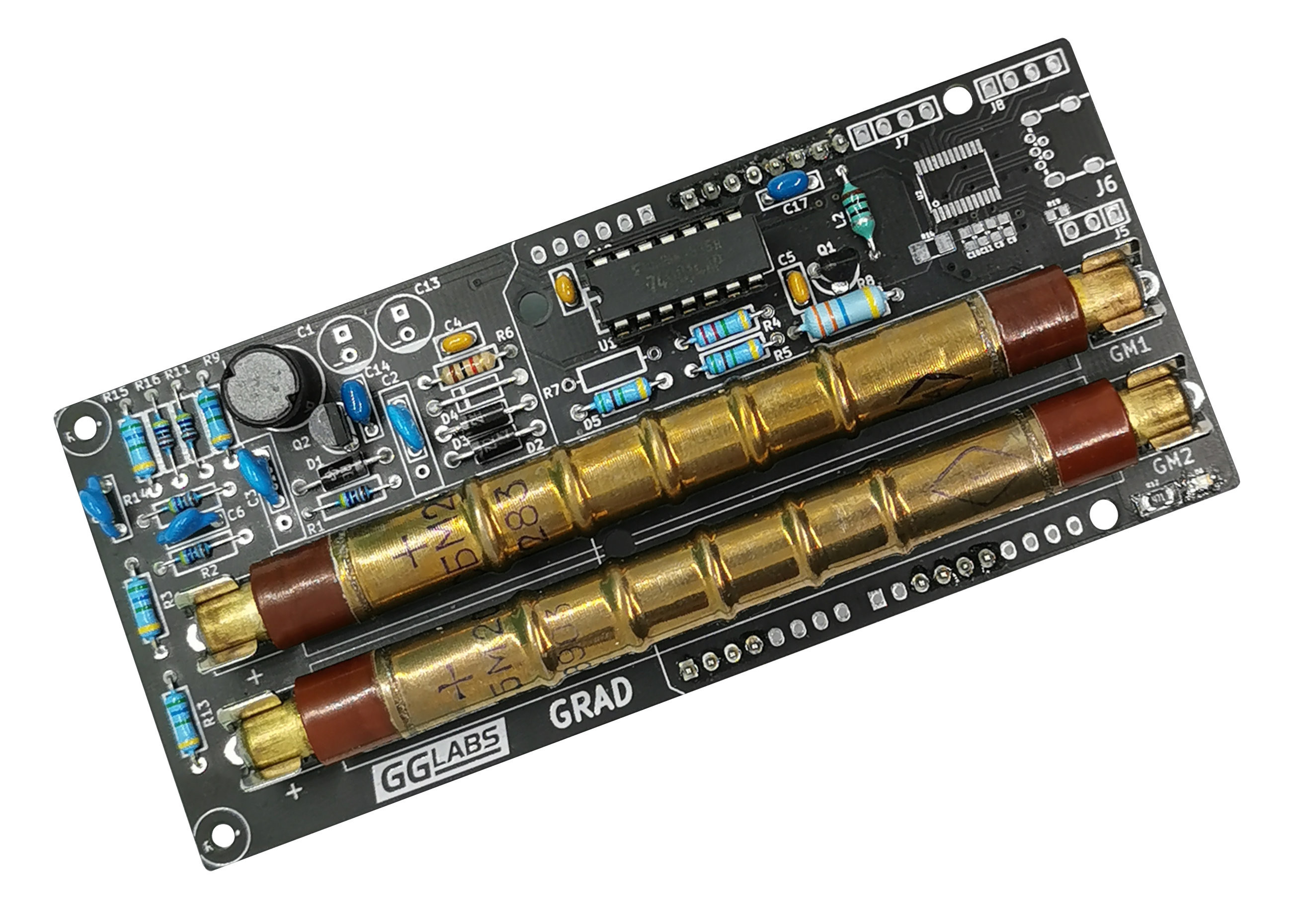
Arduino-Shield für zwei Geiger-Müller-Zählrohre
Ein hochempfindlicher, sehr stromsparender Strahlungsmesser
Want to build a project?
Bring your design to life with the Elektor PCB Service, powered by Eurocircuits. Upload the project files and order professionally manufactured PCBs or assembled boards through a proven European production platform.
Supporting KiCad, Eagle, Gerber, and ODB++ formats, the service is suitable for everything from prototypes and validation builds to series production and volume manufacturing.
Made in Europe. Fast. Reliable. Professional.
Materialliste
Stückliste
Widerstände:
R1,R2,R11,R14,R16 = 330 k
R3,R9,R13,R15 = 5M6
R4,R8 = 2M2
R5 = 10 M
R6 = 1 k
R7,R12,R18,R20,R21 = 470 Ω
Kondensatoren:
C1,C20 = 220 µ, 6,3 V
C2,C3 = 4700 p, 1000 V
C4 = 10 n, 6,3 V
C5 = 100 p, 50 V
C6,C7 = 100 p, 1000 V
C12 = 100 n, 50 V
C14 = 1 µ, 6,3 V
C15,C16 = 4700 p, 1000 V
C18,C19 = 22 p, 50 V
Induktivität:
L1 = 4m7
Halbleiter:
D1 = Diode 1 A, 800 V
D2,D3,D4,D5 = Z-Diode 100 V, 1,5 W
D6,D7 = rote LED 3 mm (T1 und T2 auf der Platine)
Q1 = 2N3904
Q2 = MJ13003
U1 = 74HC14
Außerdem:
GM1,GM2 = Geiger-Müller-Zählrohr, z.B. SBM-20
J1,J2,J3,J4 = Anschlussleisten-Satz für Arduino-Uno-Shield
SPK1 = AC-Piezo-Summer, z.B. AC-1205G-N1LF
Diskussion (0 Kommentare)